
Home / Insights / Supplier Data Breaches
Compliance / GDPR
When Your Software Supplier Has a Data Breach: What Irish SMBs Need to Do
A possible breach at a Dublin crèche software provider is a timely prompt to check what your own suppliers must tell you, how fast, and what you do next.
On 24 November 2026, RTÉ reported a possible data breach at Little Vista, a Dublin childcare management software company. According to an email to childcare providers seen by RTÉ, the company said there had been unauthorised access to data, after an external party identified a vulnerability. The information it described as accessible included children’s names, dates of birth and profile photos, and contact details for parents and staff. The company said exposure was limited in many cases, that it had found no evidence its core database was accessed, and that it had taken steps to secure the affected system. RTÉ understands the company has reported the incident to the Data Protection Commission (DPC). The full scope has not been established.
It follows a separate incident involving a supplier to credit unions. On 17 November, RTÉ reported that the DPC had received numerous breach notifications and was assessing them as a priority. The Record reported that the attack happened in early October, and that affected credit unions were not told until 16 November, after the supplier’s initial investigation had not found a data protection breach. Nothing in these reports links the two incidents. What they share is a question every business should be able to answer: if one of your software suppliers has a problem tonight, what happens next?
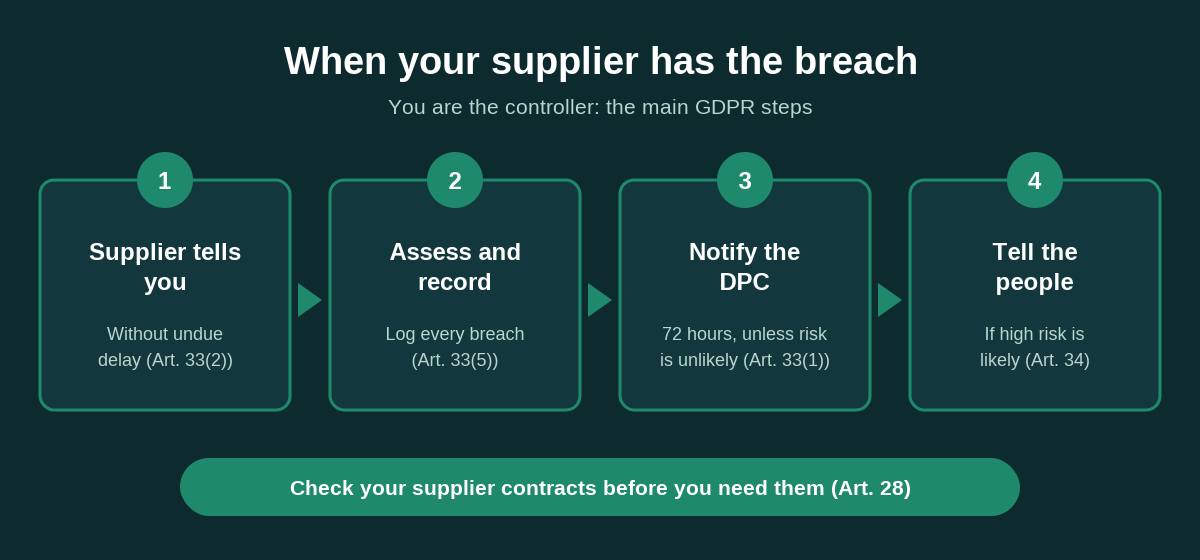
Using a supplier does not hand over responsibility
When a software company processes personal data on your instructions, you are usually the controller and it is your processor. Roles depend on the facts, so check each relationship. Article 28 of the GDPR requires you to use only processors that give sufficient guarantees about protecting data, and to have a written contract with them. That contract must, among other things, require the processor to help you meet your security and breach notification duties.
Where the 72 hours fit
Under Article 33, a processor must tell the controller about a personal data breach without undue delay after becoming aware of it. The controller must then notify the DPC without undue delay and, where feasible, within 72 hours of becoming aware, unless the breach is unlikely to result in a risk to people. If you do not yet have every detail, you can provide information in phases. Whatever you decide, record the breach and your reasoning. Our plain-English guide to the 72-hour rule covers this in more detail, and the free GDPR breach helper works out your deadline and gives you a printable log.
Where a breach is likely to result in a high risk to individuals, Article 34 generally requires you to tell them without undue delay too. The GDPR says children’s personal data merits specific protection, so take particular care when assessing risk if children are involved. If a supplier sends you a notice, do not assume it has reported to the DPC on your behalf. Confirm in writing who is notifying whom.
Five questions to ask your suppliers now
Start with the systems that hold customer, staff, payment or children’s data. First, do you have a signed data processing agreement with each supplier? Second, how quickly must it tell you about a security incident? “Without undue delay” is the legal baseline, but a contract can also set a firm number of hours and name who gets contacted. Third, which logs does it keep, and for how long? Without them, it may be impossible to say whose records were accessed. Fourth, which sub-processors does it rely on? Fifth, can you export your data and remove its access if you need to?
Make sure the notification address is a monitored mailbox, not one person who might be on leave. Check junk and quarantine as part of your routine too, so that an urgent warning does not sit unread.
Check what can reach your Microsoft 365
Suppliers do not only hold copies of your data. Some connect straight into your Microsoft 365 tenant. In the Microsoft Entra admin centre, review your enterprise applications and the permissions granted to each, especially those that can read mail, files or directory data. Remove what you no longer use, restrict who can consent to new apps, and check any accounts your suppliers use to sign in, including whether they have multi-factor authentication. Record why each remaining connection exists and who owns it. Test changes carefully, because removing an app can break a workflow your team relies on. This is routine work in managed Microsoft 365 and Intune.
If you receive a supplier notice
Note the date and time you received it. Ask what data was involved, whose it was, when the incident happened, what has been contained and what is still unknown. Preserve the correspondence and your own logs. Warn staff to be wary of unexpected calls or emails that use real details, and verify any request to change bank details using a phone number you already hold. Contact your cyber insurer early if you have cover, and get legal or data protection advice where the risk is significant.
If you would like help listing your suppliers, reviewing their access and writing down an incident process, see our IT compliance and NIS2 readiness service. This article is general information, not legal advice, and reflects reporting available on 25 November 2026.